When people think of Gangnam, they often imagine the glittering luxury and the picture-perfect lifestyle made famous by K-dramas. They see the sleek skyscrapers of Teheran-ro and the flagship designer stores of Cheongdam-dong. But for those who live here, the city tells a much more nuanced story.
In this Gangnam Neighborhood Guide, I want to take you beyond the neon lights by exploring the 3 Key Differences between Taebuk and Taenam. What many outsiders don’t realize is that locals divide Gangnam into two distinct worlds separated by Teheran-ro. Whether you live in the North (Taebuk) or the South (Taenam) dramatically reshapes your daily lifestyle, parenting philosophy, and social circle. Understanding this “invisible border” is the true starting point for anyone looking to experience real life in Gangnam.
The Origin of Teheran-ro and the “Taebuk vs Taenam” Divide in Gangnam
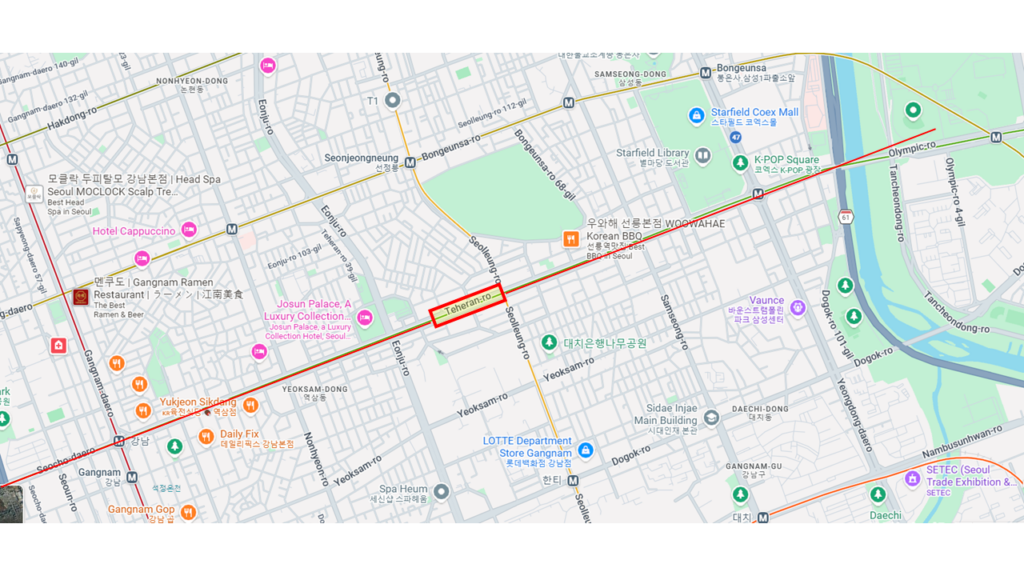
Teheran-ro is one of the most important roads in Gangnam, Seoul. The name comes from Tehran, the capital of Iran. In 1977, Seoul and Tehran established a sister-city relationship. To commemorate the friendship, a major road in Gangnam was named “Teheran-ro,” while a street in Tehran was named “Seoul Street.” Today, Teheran-ro is known as the business and tech corridor of Seoul, often compared to Silicon Valley because many IT companies, startups, and corporate headquarters are located there.
https://en.wikipedia.org/wiki/Teheran-ro
Beyond geography, Teheran-ro also acts as a cultural and social dividing line within Gangnam. Locals often use the road as a reference point to describe two different parts of the district:
Taebuk (north of Teheran-ro)
This area includes neighborhoods like Apgujeong and Cheongdam. It is traditionally associated with old wealth, luxury lifestyles, and long-established elite families.
Taenam (south of Teheran-ro)
Areas such as Daechi, Dogok, and parts of Gangnam’s residential districts fall here. This side is often linked to professional middle-class families and Korea’s famous education culture, with a strong focus on academics and private education.
Because of these differences, locals sometimes jokingly say that crossing Teheran-ro feels like entering a different version of Gangnam.
Quick Guide: Taebuk vs Taenam
| Area | Known For |
|---|---|
| Taebuk | Old money, Luxury lifestyle, Apgujeong & Cheongdam |
| Taenam | Education-oriented culture, Hagwons(Academies), Daechi-dong |
As a mom living in the heart of Daechi-dong, I’ve seen firsthand that this divide isn’t just about geography—it’s about values, parenting philosophies, and the different ways people define “success.”
My relationship with this district started long before I moved here. When I first came to Seoul for university from a small town, the word “Gangnam” itself carried a specific weight. It was an image of sophisticated taste, fine dining, and an exclusive world of the wealthy.
I remember looking at my seniors and peers who were “from Gangnam.” They had a certain aura of leisure and ease that I felt I lacked. If you’ve seen the Korean film Architecture 101, you might imagine the image of Jaewook, the confident architecture senior in the movie—that kind of effortless Gangnam aura. Looking back, I’m not sure if that aura was real or if it was just my own “Gangnam Lens Filter” coloring my perception.


Even though I lived in a modest space with my sister near my campus in northern Seoul, I found myself drawn to Garosu-gil every chance I got.
Back then, Garosu-gil was the beating heart of Gangnam’s trend scene, unlike the quieter, vacant-storefront versions you might see today. I vividly remember sitting at the now-closed Coffee SMITH, a landmark of that era. Its wide-open second-floor terrace allowed you to look down at the bustling crowds below. Sipping coffee while watching the world go by on that street, my cup was filled with a mix of longing and a youthful fantasy of what life in Gangnam might be.
Fast forward to today, having lived in Gangnam for years and raising my own children here, I’ve realized that the “fantasy” I had as a student was only half the picture. The Gangnam I once idolized is not a single, unified place.
1. Gangnam Neighborhood Guide : Old Money vs. New Money
The atmosphere shifts noticeably as you cross the Teheran-ro boulevard, and it all starts with the origin of wealth.
Taebuk, The Inheritance of Heritage


This is the land of true “Old Money.” In Taebuk, it’s not just the parents who are wealthy; the family’s prosperity often dates back to grandfathers or even great-grandfathers who owned Gangnam’s real estate or businesses long before the district’s legendary development. Here, status isn’t something that needs to be proven; it simply is. Most of the younger generation has received substantial assets through gifts or inheritance, meaning their lifestyle is fueled by generational wealth and real estate holdings rather than just an active monthly salary. It’s a world of private galleries, hidden boutiques, and a sense of “established” security.
Taenam, The Meritocracy of “New Money”




In Taenam, the story is about wealth built through intense education, discipline, and professional grit. Unlike the generational estates of the north, the wealth here is often “self-made” by the current or previous generation. This area is shaped by highly-educated, high-income professionals—doctors, lawyers, and high-income professionals. Their assets weren’t handed down through centuries; they were meticulously built through high professional earnings and strategic investment income. In Taenam, success isn’t just a legacy you inherit; it’s a standard of excellence that must be earned and maintained through relentless effort.
2. Sophisticated Leisure vs. The Academic Engine
In Gangnam, how you spend your Tuesday afternoon says a lot about which side of the line you’re on.
Taebuk’s Private Pace
There’s a certain physical and emotional “distance” in Taebuk. Life moves at a more private, individual pace. While academic achievement is still a priority, it’s less visible on the streets. The focus remains on “lifestyle curation”—wellness, art, fashion, and global travel—reflecting a life that has the freedom to focus on taste over competition.
Taenam’s Daechi-dong Education & The “Ride” Culture



Life in Taenam is incredibly structured, fast-paced, and for the parents, it is kind of exhausting. It’s the ultimate reflection of Korea’s “Palli-Palli” (hurry-hurry) culture. Education is the sun that the entire family revolves around. Living in Daechi-dong, the intensity isn’t just a rumor; it’s a physical presence. Every night around 10 PM, the streets become a sea of private cars. This is the famous “Daechi-dong Ride Culture.” Parents line up their cars an hour early just to pick up their children the moment they step out of their hagwons (private academies). The bumper-to-bumper traffic is a nightly ritual, a silent testament to the collective obsession with academic success.
But the race starts much earlier than you’d think. In Taenam, the pressure begins as early as age four. It might sound extreme—even a bit “abnormal” to those outside this bubble—but here, “4-year-old exams” for elite English kindergartens are a reality. By the time most children are learning to play, Taenam kids are already being groomed for a lifelong marathon of exams and strategic placement. For these families, education is seen as the most reliable way to replicate the professional success the parents achieved, starting from the very first steps of childhood.
3. The “Mom Lifestyle”: Trend-Setting Globetrotters vs. Master Strategists
This is where I feel the divide most acutely in my daily life. As a mom of an 8-year-old and a 5-year-old, the “Taebuk vs. Taenam” choice is a constant conversation during school pick-ups and weekend playdates.
Taebuk mom, The Trend-Setter & Cultural Curator
Historically, Taebuk moms have prioritized a well-rounded, “global” upbringing. Since their family wealth often didn’t originate from grueling academic competition, they tend to be more “sincere” about education in the arts, music, and sports. You’ll see them at elite English kindergartens in Hannam (just across the bridge) or exploring experimental art classes in Sinsa.
Having been educated abroad themselves, they often plan for their children to attend schools in the U.S. or Europe, focusing on extracurricular activities rather than just rote memorization. Her aesthetic reflects the quiet luxury of Taebuk—trend-forward athleisure, the perfectly undone Korean kkun-an-kkun look, and a Birkin or Kelly casually slung over her arm as if it were just another everyday tote.
However, there’s a hilarious new trend among Taebuk moms lately. Word on the street is that they are starting to push academics just as hard as the Taenam moms! The reason? There’s a running joke that they realized if they don’t educate their children properly, the kids will just “spend away all of Grandpa’s hard-earned fortune.” They’ve come to the painful (and funny) realization that to protect the family assets, their children actually need to know how to manage them, and that starts with a solid education. For example, there are newly opened English kindergartens for young children, such as “Daechi English Park (DEP)” in Apgujeong (Dosan Branch), which is known for its intense curriculum and heavy homework load.

Taenam Mom: The Master Strategist & The Pursuit of the “God-Tier” Goal
She is the COO of her household. Living in Taenam (specifically Daechi-dong) means residing at the epicenter of the world’s most competitive education market. Her “logistics” are legendary; she manages complex grids of math academies, English prep, swimming, and music lessons, often all within a hyper-dense five-block radius.
The community here is incredibly tight-knit, bound by the shared, high-stakes goal of navigating the rigorous Korean school system with surgical precision. Unlike the Taebuk mom’s “global” vision, the Taenam mom’s focus is on mastery within the system. Her pride comes from seeing her child conquer the next level of a competitive math tier or securing a spot in a top-tier hagwon.
In fact, even children from the most privileged families are not outside this culture. One widely discussed example was the grandson of Lee Kun-hee, the late chairman of Samsung, and the son of Hotel Shilla president Lee Boo-jin. Despite his extraordinary family background, he was known to attend hagwons in Daechi-dong and study as intensely as any other student. His eventual admission to Seoul National University’s business school became a widely talked-about story, often cited as an example of how powerful the academic culture in this district can be.
In this high-stakes ecosystem, there is one ultimate trophy that stands above all others: Admission to a major medical school in Seoul. To a Taenam family, the medical profession isn’t just a career—it is viewed as “God-tier” status. In an era of deepening economic uncertainty, a medical license offers what we call the “holy trinity” of professional life: guaranteed stability, no mandatory retirement age, and an exceptionally high income. While the preference for medical schools has always been a staple of Korean culture, the recent “Medical School Obsession” has reached a fever pitch. It’s no longer just about the noble calling of being a doctor; it’s about securing a life that is “future-proof.”
For a Taenam mom—especially one whose child shows academic promise—motherhood often feels like running a small logistics company. Every grueling “ride” at 10 PM and every hyper-strategic math schedule is a carefully placed brick in the long road leading toward that coveted white coat. In Daechi-dong, we aren’t just raising children; we are meticulously engineering their future.

Which Edit Suits Your Life?
Today, as a mom of two in the heart of Daechi-dong, I live the life of the “Master Strategist” I described. My days (and my kids as well) are filled with hagwon schedules and endless car pick-ups.
But sometimes, in the quiet moments between the “rides,” I find myself wondering: What if we lived in the North? What if we were in the leafy streets of Apgujeong instead of the high-rise intensity of Daechi? Would the way I look at my children change? Would my parenting philosophy soften, or would my daily rhythm find a different melody?
The more I reflect, the more I realize that while our surroundings undeniably shape us, the most important “edit” isn’t the one we make to our address—it’s the one we make to our own core values. Geography influences our pace, but our internal compass dictates our direction.
Is it too greedy of me to want the best of both worlds? To embrace the Taebuk mom’s grace which is her focus on wellness, mindfulness, and the quiet luxury of leisure, while holding onto the Taenam mom’s brilliance such as her strategic thinking, planning, and legendary multitasking?
Many years ago, as a college student sitting on that terrace at Cafe SMITH, I looked at Gangnam through a lens of pure fantasy. Back then, it was a dream of “becoming.” Today, it’s a reality of “belonging” and “building.” I often wonder what this city will look like to me in the next decade, and which version of the Gangnam dream I’ll be chasing then.
But for now, whether you are drawn to the generational heritage of the North or the meritocratic drive of the South, I hope you find the version of Seoul that lets you thrive—on your own terms.
FAQ About Gangnam
What is the difference between Taebuk and Taenam?
Taebuk refers to neighborhoods north of Teheran-ro such as Apgujeong and Cheongdam, traditionally associated with old wealth. Taenam refers to areas south of Teheran-ro like Daechi and Dogok, known for their intense education culture.
Why is Daechi-dong famous in Korea?
Daechi-dong is known as the center of Korea’s hagwon industry, where thousands of private academies prepare students for competitive exams.
Why do Gangnam parents focus so much on education?
For many families, education is considered the most reliable path to long-term professional success and social mobility.
You Might Also Like:
- While understanding the geography of Gangnam is the first step to living like a local, knowing where to shop is the second. From the skin-saving cica creams I use during school runs to the exclusive matcha snacks that fuel my site admin work, I’ve curated the ultimate shopping list for your next trip. [Don’t Leave Seoul Without These: 10+ Olive Young Must-Buys]
- You also might be wondering: How did Korea become the world’s capital of efficiency and speed? From dawn grocery deliveries to lightning-fast medical apps, the same “Palli-Palli” (hurry-hurry) spirit that created these high-performance products is what fuels our daily lives in Seoul. Please check out my previous posting [3Ways Korea’s High-Speed Lifestyle Will Amaze You]
- If you’ve enjoyed learning about Korea’s fast-paced daily life, why not discover the pinnacle of its culinary world? Check out my curated list of the finest dining experiences in the city [The Stars of 2026 Michelin Guide Seoul & My Personal Best 3]
- You might wonder “what are the hidden rules Koreans live by?” From the red ink myth to why we don’t shake our legs, explore 7 fascinating superstitions that still shape Korean lives today!” Please check out my previous posting on [7 Strange Korean Superstitions Every Homeowner Should Know]
- Understanding these superstitions is just the beginning of discovering the beauty of Korean heritage. For a deeper look into our most celebrated holiday, check out my guide on [Embracing Korean traditions during Seollal]
- Looking for more luxury inspiration in Seoul? Don’t miss my story about a restorative family staycation at the Four Seasons Hotel Seoul. It was the perfect break before the kids started their new school year! More details on [The Ultimate Gwanghwamun Guide: BTS Performance Spot, 4 Must-Try Experiences at Four Seasons Seoul, and MMCA Art]
