The mere mention of the word “gift” brings a smile to our faces. What’s even more magical about gifting is that while receiving a present is wonderful, giving one often brings an even deeper sense of happiness. It’s the heartwarming realization that someone spent their precious time thinking of you, trying to figure out what would make you happy.
However, finding the perfect gift can be a subtle art. It requires a genuine understanding of the recipient’s lifestyle, tastes, and preferences. This becomes even more complex when weaving through different cultural backgrounds. What is considered a thoughtful gesture in one culture might feel overwhelming or misplaced in another, as Korean gifting culture—and the unspoken societal expectations behind it—holds its own unique rules.
If you are living in South Korea or have Korean friends, understanding the core dynamics of Korean gifting culture is essential, especially when you notice a unique local phenomenon: Koreans love gifting cash.
To many global readers, handing over a crisp envelope of cold, hard cash might feel transactional, impersonal, or even a bit taboo. But in Korea, exchanging cash envelopes is far from lazy gifting. Instead, it is a profound expression of Jeong (정—a deep emotional bond) and solidarity. It is a tangible way of saying, “I am standing by your side, celebrating your highest highs and supporting you through your lowest lows.”
Interestingly, these cash gifts aren’t just random amounts decided on a whim. They are governed by a delicate, invisible set of “social rules” and etiquette that every local sub-consciously follows.
Moreover, Korean gifting traditions extend to physical presents with fascinating twists. If you are ever invited to a Jipduri (집들이—a Korean housewarming party), the most appreciated gifts are tightly intertwined with ancient Korean superstitions that might completely surprise you.
In this post, we’ll dive deep into the clever, warm, and deeply rooted culture of mutual aid (Sangbu-sangjo) in Korea. Get ready to become a true cultural insider!
1. Housewarming Gifts Rooted in Superstition (Jipduri)
In many Western cultures, bringing a nice bottle of wine, a scented candle, or a bouquet of flowers is the gold standard for a housewarming party. However, if you step into a Korean Jipduri (집들이), you might be baffled to see guests arriving with massive bundles of toilet paper, rolls of paper towels, or heavy jugs of laundry detergent.
No, Koreans aren’t hinting that their host needs to clean up. These seemingly mundane, ultra-practical grocery items actually carry brilliant linguistic puns and heartfelt blessings for the host’s future.
If you want to surprise your Korean friends with your “insider” knowledge, here is the secret symbolism behind these classic Korean housewarming gifts:
Roll Toilet Paper & Paper Towels: “May Everything Unravel Smoothly”
In Korea, toilet paper is much more than a bathroom essential; it is a metaphor for a smooth life. The symbolic meaning comes from the physical act of unrolling the paper. Just as a roll of toilet paper unravels effortlessly and smoothly, it represents the wish that all of the host’s future endeavors, business, and daily life in the new home will “unravel easily without a hitch” (술술 풀려라).
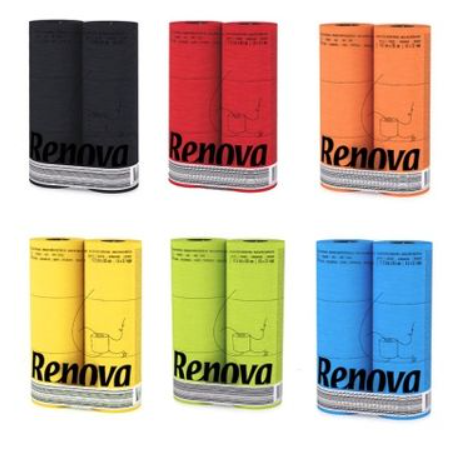
If you feel a bit self-conscious walking into a beautiful new apartment carrying a plain pack of supermarket toilet paper, you can elevate this tradition! For a friend’s housewarming, I once gifted a pack of Renova colored toilet paper. Since they come in vibrant, chic colors, they double as an eye-catching interior decor piece while perfectly keeping the traditional meaning intact. Needless to say, it was an absolute hit, and I was praised for being an incredibly thoughtful guest!
Detergent & Soap: “May Your Wealth Bubble Up”
Another staples of Korean housewarming gifts are laundry detergents, dish soaps, and artisanal hand soaps. The magic here lies in the bubbles. As you use these products, they naturally create a rich, overflowing foam. In Korean culture, these rising bubbles symbolize wealth, luck, and prosperity multiplying and “bubbling up” into a massive fortune. It’s a playful yet sincere way of wishing the host financial abundance in their new chapter.
2. The Cash Envelopes: Decoding Wedding Gift Money (Chugwigeum)
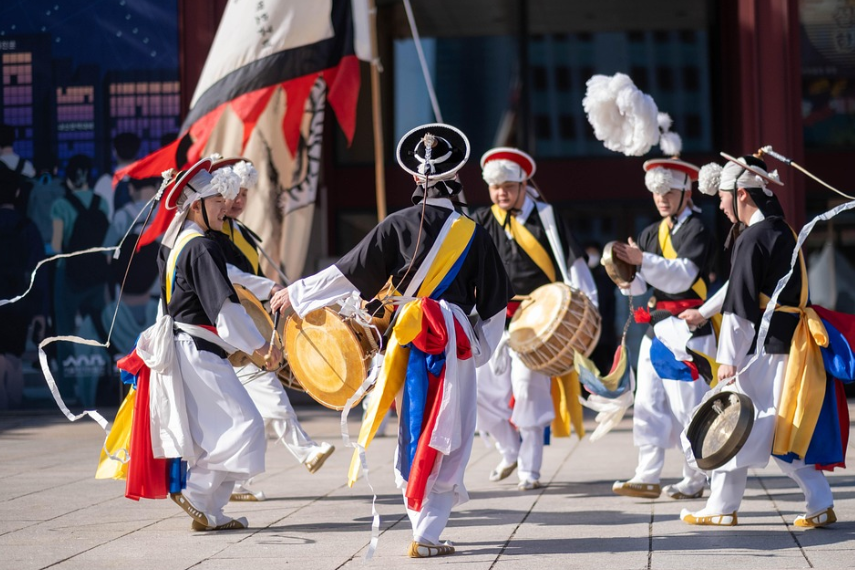
In Korea, major life milestones—such as weddings, a baby’s first birthday party (Doljanchi / 돌잔치), or a grand 60th birthday celebration (Hwan gap / 환갑)—are celebrated with a festive gathering called a Janchi (잔치). While modern Koreans increasingly prefer smaller, intimate gatherings with immediate family, the deeply ingrained cultural desire to share good fortune and offer blessings remains as strong as ever.
If you are ever invited to one of these joyous occasions, you will need to prepare a cash envelope called Chugwigeum (축의금—Congratulatory Gift Money). To the untrained eye, throwing money into an envelope seems simple. However, there is a fascinating cultural algorithm behind the exact amount you should give.
Yin, Yang, and the Secret of Odd Numbers
Why do Koreans meticulously count their bills? It goes back to Yin and Yang and the Five Elements (Eumyang-oohaeng).
Traditionally, odd numbers (3, 5, 7) are viewed as Yang (陽), representing light, positive energy, and good luck. Conversely, even numbers are viewed as Yin (陰), associated with darkness and bad omen. Therefore, when gifting cash, Koreans have historically stuck to odd numbers: 30,000 KRW, 50,000 KRW, or 70,000 KRW.
The 100,000 KRW Exception
“Wait, isn’t 10 an even number?” You are absolutely right. However, 10,0000 KRW is the ultimate exception to the rule. In Korean numerology, 10 is seen as a “complete or full number” because it represents the completion of the lucky odd numbers 3 and 7 ($3 + 7 = 10$). Because it symbolizes fulfillment and ultimate balance, 100,000 KRW is considered an exceptionally auspicious and polite amount to gift.
The “Closeness Scale” vs. Modern Inflation
How much should you actually put in the envelope? It entirely depends on your relationship tier with the host.
However, this unwritten social contract is shifting due to rising inflation. A few years ago, 30,000 to 50,000 KRW was the standard etiquette for a standard coworker or casual acquaintance. But today, with the skyrocketing costs of wedding venues and buffet catering (which often exceed 60,000 to 80,000 KRW per person), the baseline has moved.
Nowadays, the prevailing consensus is that 100,000 KRW is the new minimum if you plan to attend the wedding in person and enjoy the meal, ensuring the couple doesn’t lose money on your attendance.
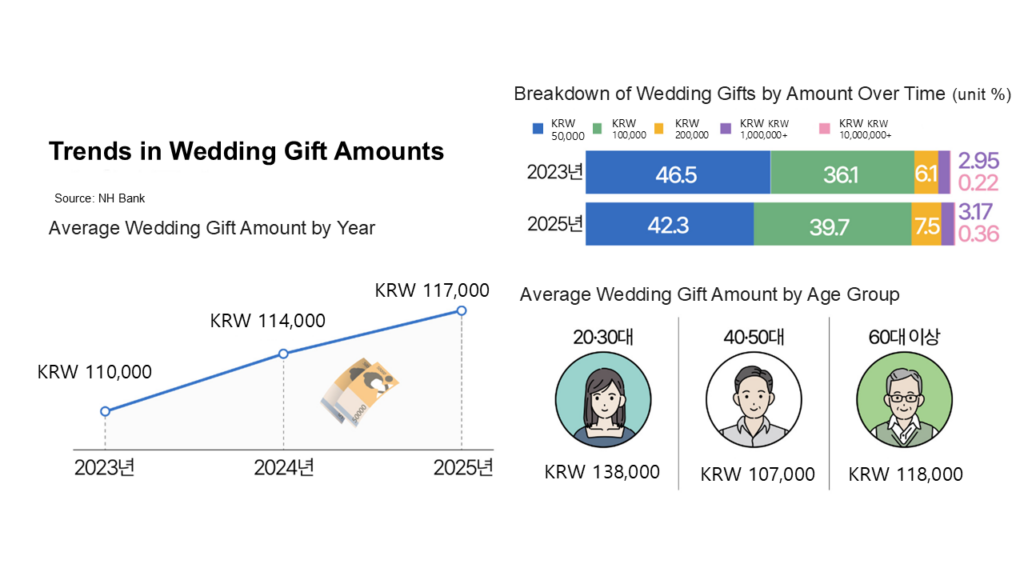
Quick Reference: Wedding Gift Trends in Korea
source: NH Bank (2026)
| Wedding Gift Amount by Year (연도별 평균 축의금) | Trends in Wedding Gift Amounts (축의금 변화) | Breakdown of Wedding Gifts by Amount Over Time (액수별 비중) |
| Past Average | KRW 50,000 (Approx. $36) | Dominated by KRW 30K / 50K |
| Recent Transition | KRW 110,000 ~ 117,000 (Approx. $80~85) | Shift to KRW 100K as baseline |
| Premium / Close Friends | KRW 200,000+ (Approx. $144+) | KRW 200K+ or Over KRW 1M for family |
3. Sharing the Weight of Sorrow: Korean Funeral Etiquette (Joeuigeum)
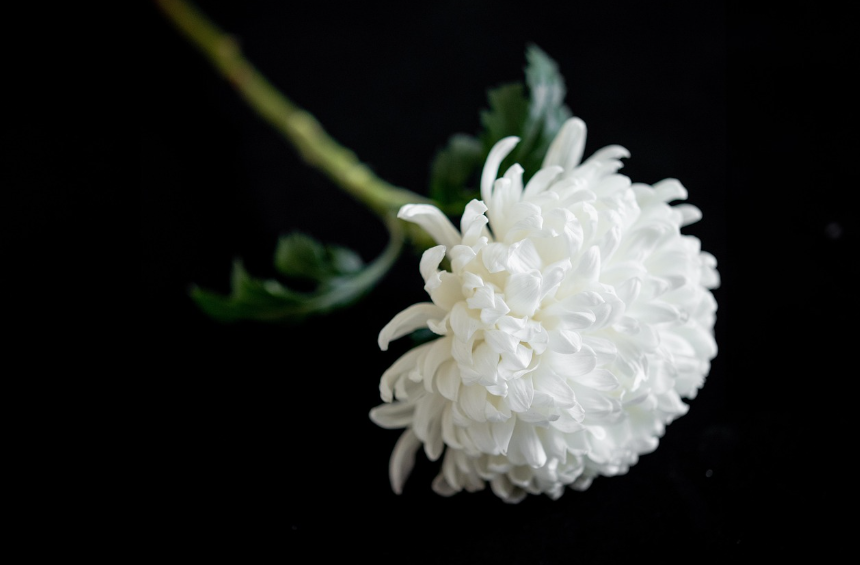
Just as Koreans gather enthusiastically to celebrate life’s joys, they stand together with equal devotion during life’s ultimate sorrow: death. Entering a Korean funeral (Jomon / 조문) requires the highest level of respect, decorum, and cultural awareness.
While demographic shifts suggest that the younger MZ generation may choose even more simplified, private rituals in the future, traditional funeral customs remain highly active and deeply respected today.
White Envelopes and the Spirit of Pumassi
Similar to wedding gift money, when you attend a Korean funeral, you bring a cash gift wrapped in a plain white envelope called Joeuigeum (조의금—Condolence Money).
While the exact numbers follow the same “odd-number rule” (30,000, 50,000, 70,000, or the exceptional 100,000 KRW) based on your closeness to the deceased or the family, the underlying meaning is profoundly different from a wedding.
Funeral cash is a modern extension of Pumassi (품앗이—communal sharing of labor and costs). Hosting a multi-day funeral in Korea is incredibly expensive. By slipping cash into that envelope, you are literally helping the grieving family cover the funeral costs, ensuring they do not bear the financial burden of their loss alone.
Taboos: What You Must NEVER Do at a Korean Funeral
Because a funeral is a sacred space for sending off the deceased, certain unspoken taboos carry heavy weight. To avoid accidental disrespect, keep these strict rules in mind:
1. Never Write Names in Red Ink
Never Write Names in Red Ink: Upon arriving at the funeral hall, you will find a guestbook near the condolence box where you must write your name down. Ensure you never pick up a pen with red ink. As I deeply explored in my previous post, 7 Strange Korean Superstitions Every Homeowner Should Know, writing a living person’s name in red ink is a major cultural taboo that symbolizes death or bad luck. At a funeral, this unsettling superstition is magnified tenfold. I bet there won’t be a red ink pen on the desk for sure. Stick to black or dark blue ink.
2. Dress in Strict, Modest Black
Your attire speaks volumes before you even say a word. Korean funerals demand conservative, dark clothing.
- For Men: A sharp black suit, a black jacket, or at least a dark, collared long-sleeve shirt is standard protocol.
- For Women: A modest black dress, trousers, or a clean-cut dark outfit is required. Flashy, brightly colored clothing or anything revealing is considered highly offensive and is forbidden.
3. Leave Loud Accessories at Home
The unwritten dress code is to blend into the background out of respect for the family’s grief. While simple watches or minimalist stud earrings are perfectly fine, leave your statement necklaces, stacked bracelets, or towering high heels at home. Simplicity is the ultimate sign of respect here.
4. Mind Your Words, even for a “Good Death” (Hosang)
In Korea, there is a specific cultural term called Hosang (호상 / 好喪), which literally translates to a “Good Death.” This term is uniquely used when someone passes away naturally after living a long, healthy, and blessed life, having seen their children grow up, establish families, and comfortably witness their final moments.
However, a trap awaits well-meaning foreigners here. Even if a passing is considered a Hosang, you should never say “It’s a good thing it’s a Hosang” or “You must be relieved it’s a Hosang” to the grieving family. To the relatives, the loss of a loved one is still an irreplaceable, heartbreaking tragedy. The best approach is to simply offer your deepest, silent condolences without labeling their grief.
Jeong: The Invisible Thread of Korean Connection
At first glance, the unspoken metrics of Korean gifting, wedding cash, and funeral etiquette might seem overwhelmingly complex, or perhaps even highly calculated because we exchange “cash” at some point. However, when you peel back the layers of rules and numbers, you find a beautifully simple emotional core.
At its heart, this culture beats with a singular, powerful rhythm: “I will celebrate your joy as if it were my own, and I will carry your sorrow as if it were my own.” This is the ultimate manifestation of Jeong (情) and Pumassi (품앗이)—the invisible threads that tie the Korean community together.
Of course, times are changing. As Korean society leans more toward individualism and the younger generations seek privacy, these grand communal traditions are noticeably scaling down. Who knows? In twenty or thirty years, the hyper-specific rituals of Chugwigeum and Joeuigeum might vanish completely, replaced by something entirely new.
While I personally agree that over-the-top, superficial formalities and social pressures should be trimmed away, I sincerely hope that the spirit behind them never disappears. Because strip away the complex rules, and what we are left with is the purest form of human connection: genuinely laughing together in times of light, and quietly holding each other’s hands in times of darkness.
As the world moves faster and becomes more digital, perhaps these “bothersome” traditional gestures are exactly what keep us grounded and connected.
You Might Also Like:
- Catch the absolute best of Seoul’s early summer breeze. From hidden green sanctuaries to the most photogenic riverside spots, here is your ultimate local guide to experiencing the city in June.[Seoul Travel Guide: Best Things to Do in Early Summer (June Edition)]
- Discover the quiet beauty of Korea’s grandest lunar holiday. We explore how timeless family traditions, elegant hanbok aesthetics, and artisanal seasonal treats are being beautifully reimagined by modern generations. [The Elegance of Seollal in Korea: Embracing Korean Traditions with Style and Sweetness]
- Stay ahead of the curve with the definitive lifestyle shifts defining South Korea this year. From high-tech wellness transformations to the revolutionary changes shaping the next K-Pop frontier, here is what’s driving the culture forward. [5 Unstoppable South Korea Trends in 2026: From Wellness Wealth to K-Pop’s New Era]
- Ever wondered how K-Pop evolved from 90s hip-hop roots into a global phenomenon? Written from a true millennial perspective, this comprehensive guide decodes the sound, style, and cultural impact of all five distinct idol generations. [A Millennial’s Guide to K-Pop History: Generations 1 to 5 Explained]
- British conceptual art master Damien Hirst makes his monumental solo debut at MMCA Seoul. Skip the confusion and go straight to the core with our expert breakdown of the 6 provocative masterpieces you absolutely cannot miss. [6 Must-See Masterpieces of Damien Hirst MMCA Seoul]
- Immerse yourself in the voluptuous, sensuous world of “Boterismo” at the Seoul Arts Center. To help you appreciate the late master’s monumental style, we unpack the 5 key artistic themes behind his historic Seoul retrospective. [The Beauty of Being Full: Best 5 Themes of Fernando Botero Exhibition Seoul]
