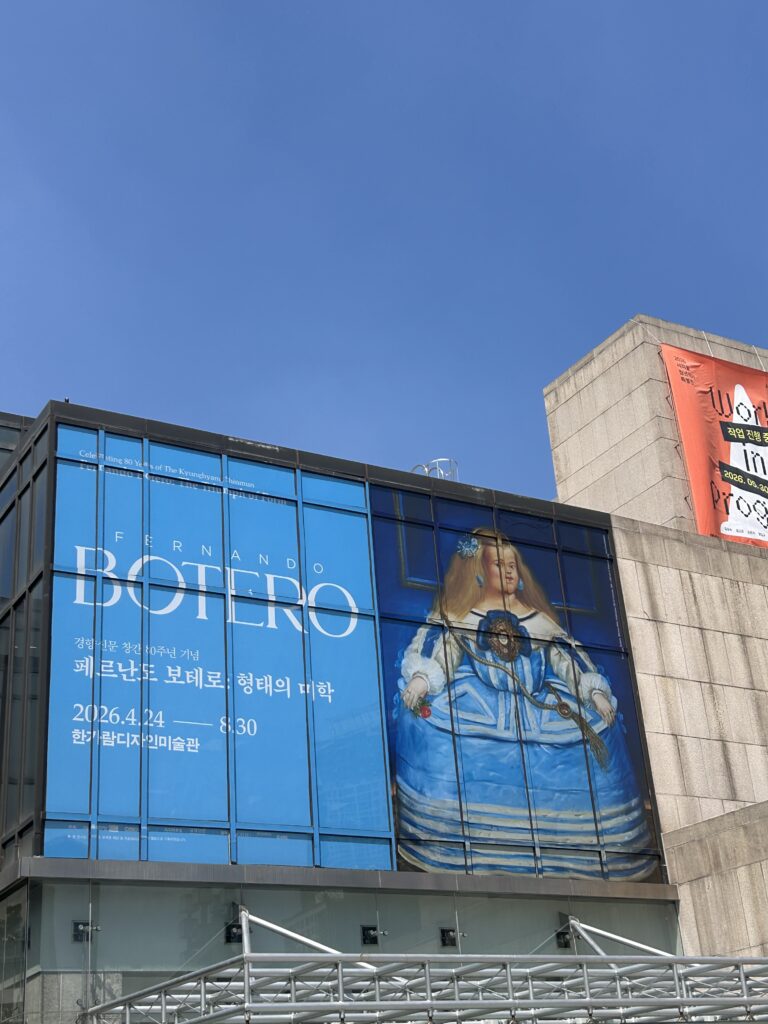
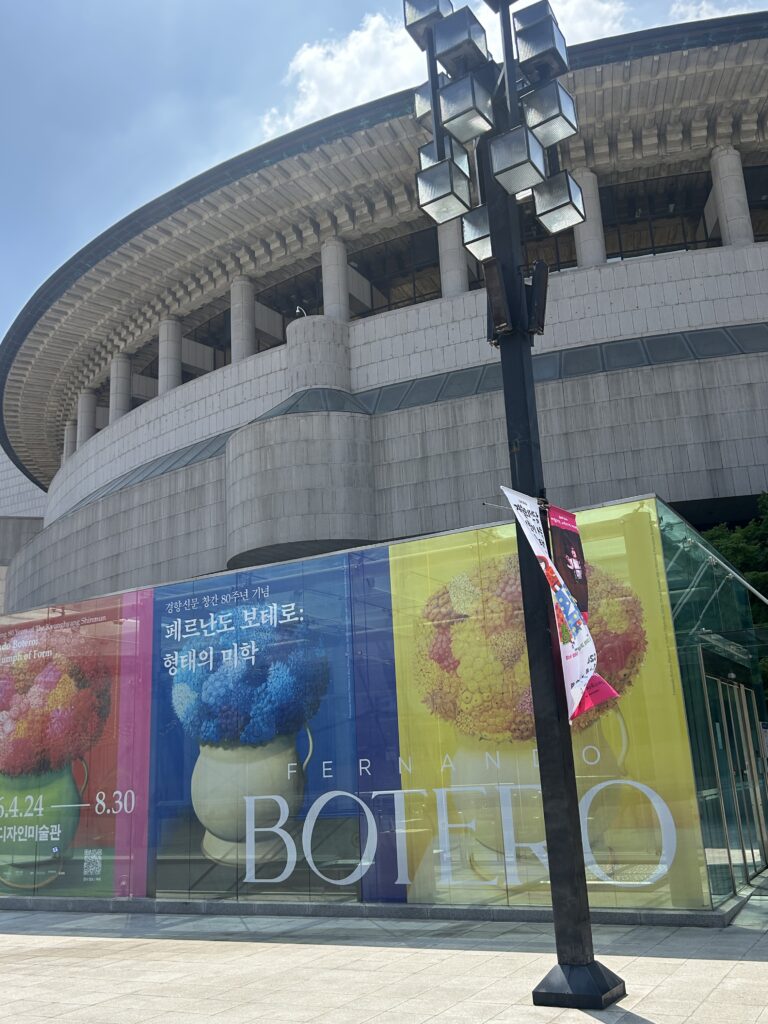
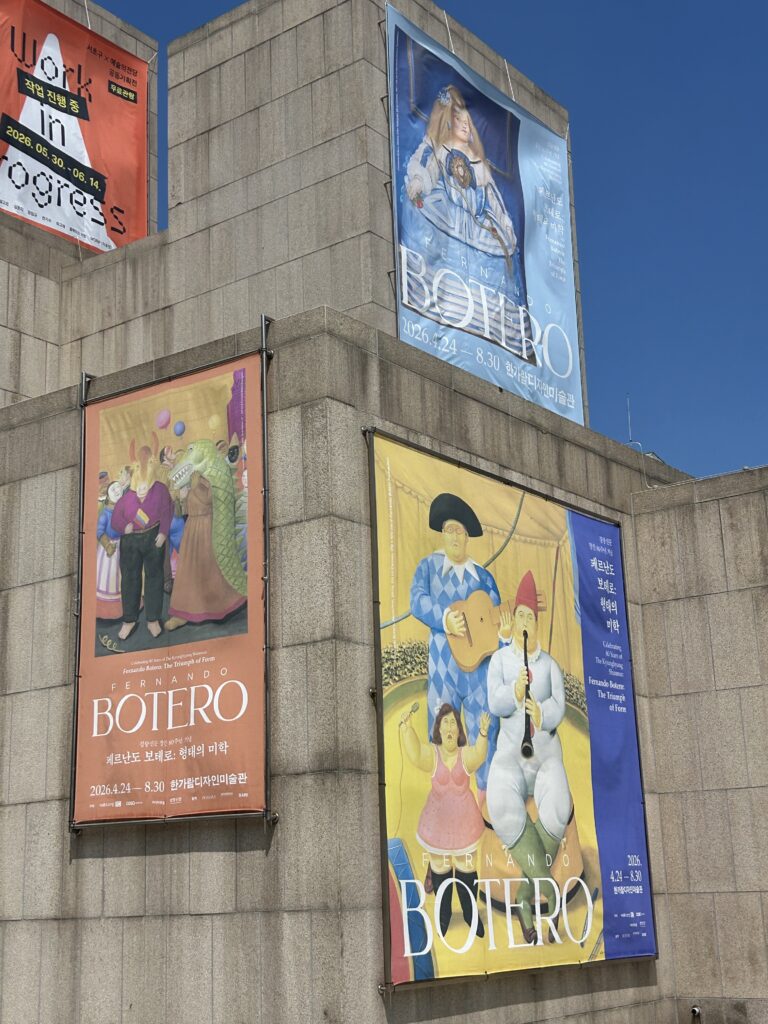
The highly anticipated Fernando Botero Exhibition Seoul is officially here, bringing a magnificent world of volume and plenitude to the heart of the city. Recently, this captivating retrospective titled “Fernando Botero: The Aesthetics of Form” opened its doors at the Hangaram Art Museum within the Seoul Arts Center.
Looking at the figures in his paintings—with their balloon-like, inflated faces and bodies contrasted against tiny eyes, noses, and mouths—you can’t help but smile. Everything he painted was deliberately expanded. Interestingly, even though the characters themselves often wear blank, expressionless faces, the overall atmosphere they exude is deeply relaxed, peaceful, and inexplicably happy.
“I do not paint fat people. I paint volume. It is about the sensuality of form, and I love this generosity.”
These words perfectly encapsulate his world. This Seoul exhibition beautifully showcases the artistry of volume and the richness of life, effortlessly transporting me into an entirely different, whimsical universe the moment I walked in.
Who is Fernando Botero?
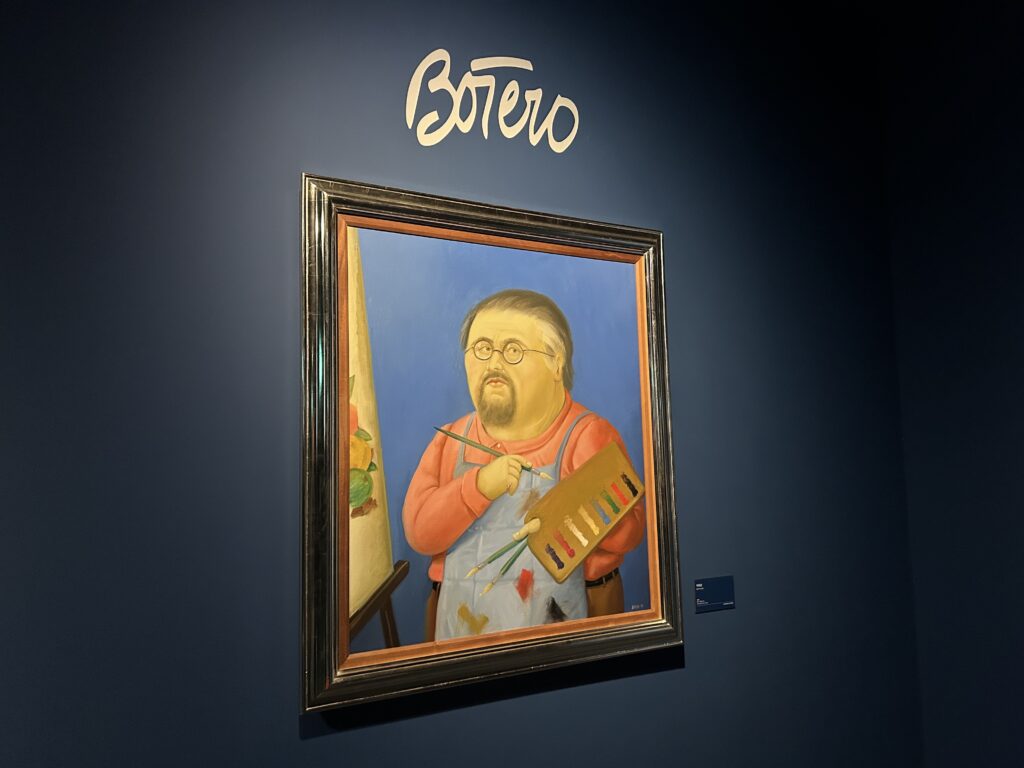
“In art, beauty and sensuality come from revealing the richness of form.”
Often hailed as the maestro of Latin American art, Fernando Botero redefined 20th-century art. Born in Medellín, Colombia, he spent his youth studying classical painting in Spain and Italy, eventually mastering a unique visual language known worldwide as “Boterismo.”
By filling his canvases with exaggerated figures and objects rendered in soft yet solid volumes, Botero infused his work with humor and profound warmth. He was never an artist who merely painted things “large”; rather, he was a master who used exaggerated forms to emphasize the weight, presence, and dignity of human existence.
Stepping into the Hangaram Art Museum, I found myself completely liberated by his world of beautiful distortion. Instead of looking at individual canvases, let’s dive into the 5 best themes that define this magnificent Seoul retrospective.
The Vibrant Pulse of Latin American Life
The exhibition truly pulses with energy in the section dedicated to Latin American life. Here, the theme isn’t just about depicting a culture; it is about capturing the raw, unapologetic joy of existence. Through a blend of bold, vibrant, and primeval color palettes, Botero illustrates local festivals, lively dances, and intimate parties. In a modern society often obsessed with restriction and strict body scales, these magnified figures move with absolute grace. This theme serves as a powerful reminder to stop taking life so seriously and embrace the sheer pleasure of living in the moment.
Through Botero’s eyes, the daily lives of Latin Americans seem beautifully woven with small moments of joy, routine, and celebration. While these figures represent the universal human experience, they carry a distinctively Latin American lightheartedness and resilience. Witnessing this profound optimism and abundance through his brushstrokes left me with a deep, lingering desire to visit Latin America one day.
The Drama of Everyday Life: “After the Party”
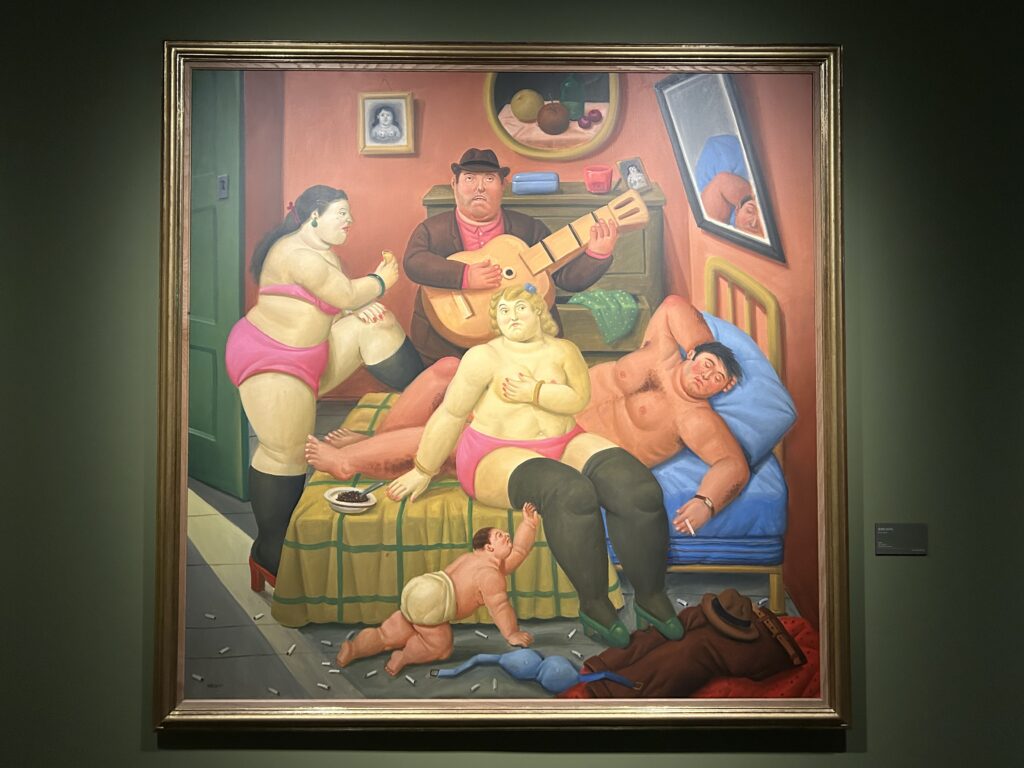
Take a close look at the masterpiece, “The End of the Festival” (also known as After the Party). The scene is brilliantly chaotic: cigarette butts are scattered messily across the floor, and one man has even fallen fast asleep with a half-smoked cigarette still loosely held in his hand. Yet, the energy of the night hasn’t entirely faded. Another man continues to play his instrument, while the woman beside him holds up a glass, looking as if she’s about to toss back one last shot.
Then there is the expressionless woman covering her chest, and a bowl of what looks like cereal sitting at the edge of the bed—perhaps a late-night snack for someone who got hungry after all that dancing? To top it all off, a toddler in a diaper crawls across the scene. The entire canvas feels incredibly alive, as if you are watching a slice-of-life drama unfold in real time.
The Quiet Weight of Motherhood: “The Widow”
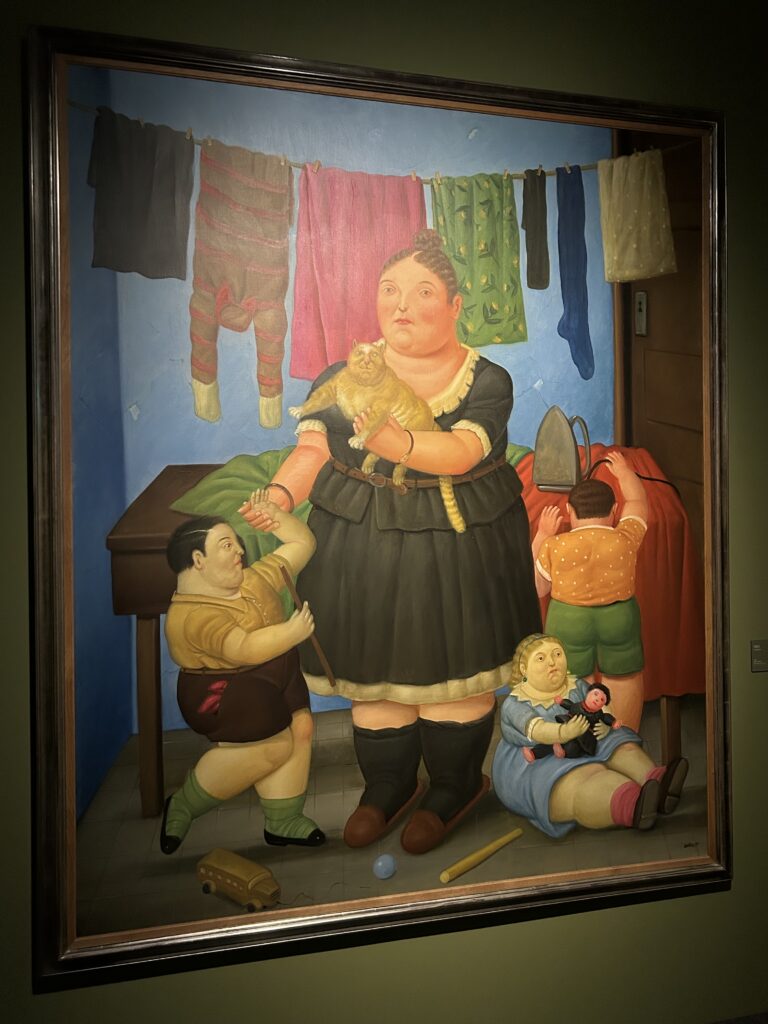
“As a mother of two myself, there was another piece that deeply resonated with me.”
The painting portrays a mother of three, accompanied by the family cat. But learning the title, “The Widow,” changes everything. It forces you to look closer and wonder: how incredibly grueling must it be to raise three young children entirely on your own, without a partner by your side?
Although the mother stands completely still, the sheer, exhausting busyness of her solo-parenting reality radiates from the canvas. Any parent would instantly recognize that weary yet steadfast aura. In the background, lines of laundry hang out to dry. Even the colors and textures of those simple garments feel so authentically Colombian, capturing the very essence of Latin America. I found myself staring at it for a long time, deeply moved by how beautifully Botero elevates the mundane, painful, and resilient chaos of single motherhood into high art.
Playful Reinterpretations of Art History
Botero’s relationship with the past is one of the most intellectually delightful themes of the exhibition. In Section 1, he takes the historically rigid, solemn profile portraits of early Renaissance masters—such as Piero della Francesca’s iconic depictions of Federico da Montefeltro and Battista Sforza—and reconstructs them through his own lens of volume. Seeing these famously austere historical figures reimagined with round, smooth, and gentle contours offers a profound sense of aesthetic wit. It proves that honoring tradition doesn’t mean copying it; it means playfully inviting it into your own whimsical universe.
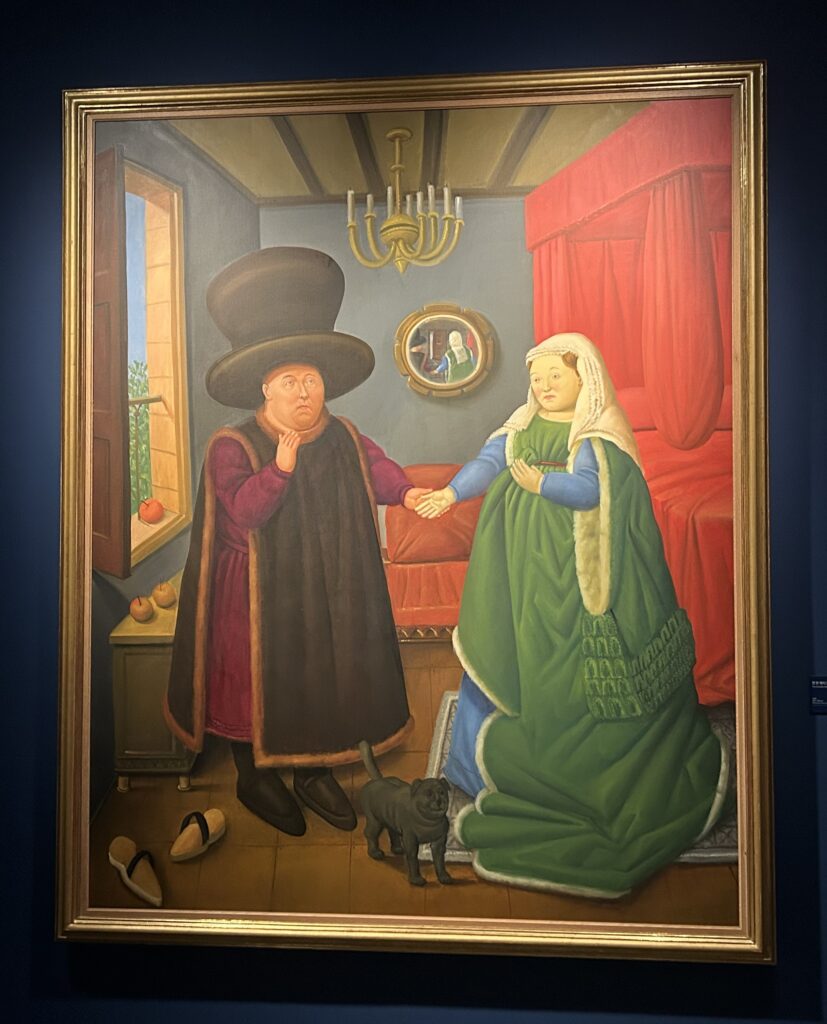
Instead of mere imitation, Botero uses his signature volume and vibrant color palette to transform familiar masterpieces into entirely new visual experiences. My absolute favorite in this category was “The Arnolfini Portrait, after Jan van Eyck.”
Masterpiece Meets Boterismo: “The Arnolfini Portrait”
The original 15th-century masterpiece by Netherlandish Renaissance master Jan van Eyck—currently housed in the National Gallery in London—remains one of the most revered paintings in art history. It is celebrated for its jaw-dropping detail and groundbreaking use of light to create a sense of three-dimensional space. Art historians have long praised it, noting that van Eyck captured not just the people living in the room, but the very essence and atmosphere of the room itself with stunning realism.
In his own version, Botero parodies this iconic wedding portrait of the Italian merchant Giovanni Arnolfini through the definitive lens of Boterismo.
If you get a chance to visit the exhibition, I highly recommend pulling up a photo of van Eyck’s original on your phone and comparing it side-by-side with Botero’s rendition. Seeing how van Eyck’s sharp, delicate realism is translated into Botero’s soft, exaggerated curves makes the viewing experience incredibly fun, fresh, and deeply engaging.

The Tactile Allure of Bronze Sculptures
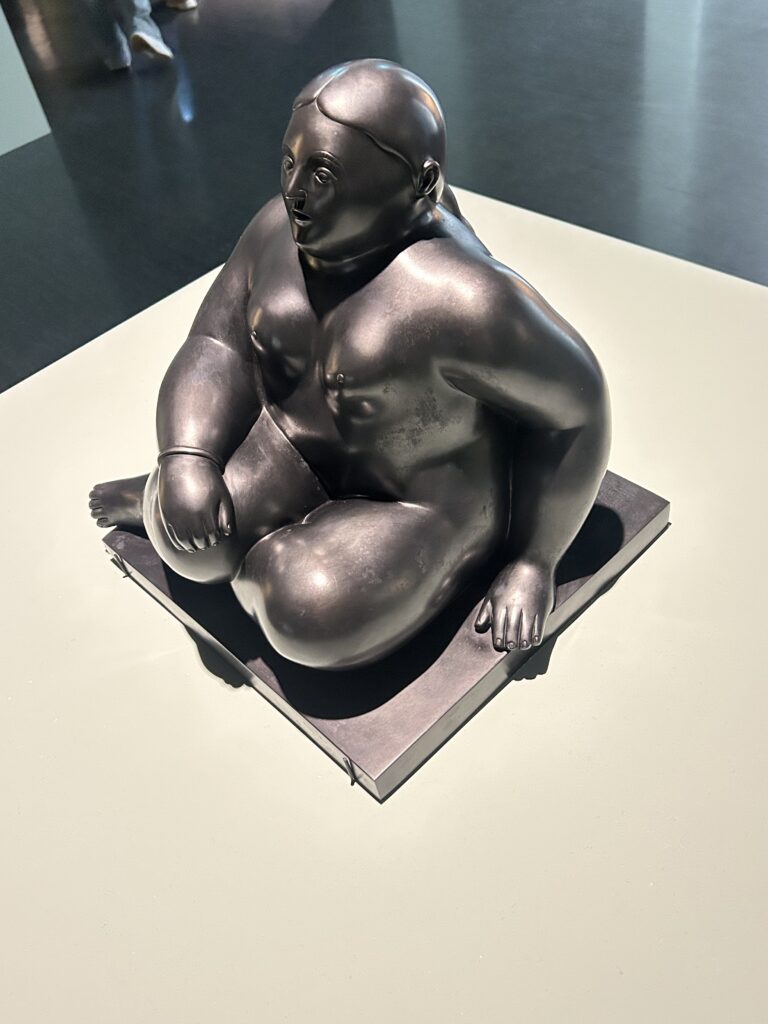
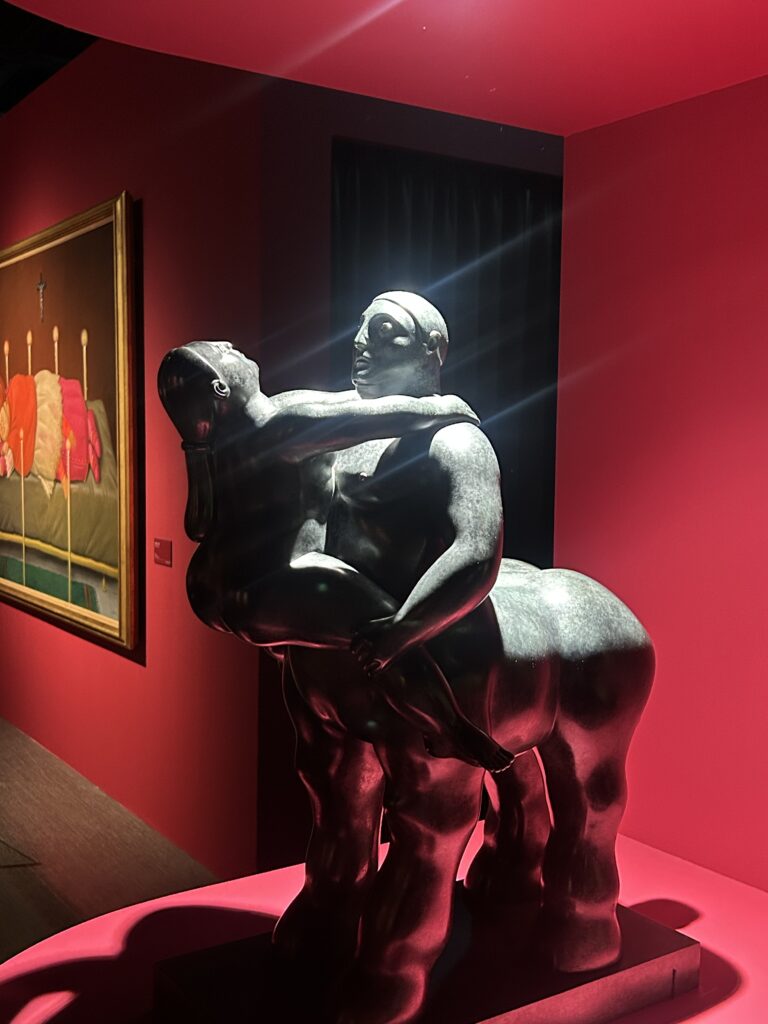
For Botero, volume was a philosophy that could not be contained within a flat canvas. As he famously noted, moving into three-dimensional forms was completely inevitable. Scattered elegantly throughout the gallery space, his bronze sculptures command immediate attention. From a delightfully plump, majestic cat to witty mythological demi-gods and sensual human figures, these forms possess a tactile allure that makes you want to reach out and touch them. The harmony between the heavy bronze material and the lighthearted, fluid lines embodies the perfect marriage of wit and sensuality.
To truly understand his sculptural world, we must look to his core belief:
“Volume has to do with a certain concept of sensuality in art: I am convinced that painting should be generous, sensual, and voluptuous.”
There is perhaps no piece in the entire exhibition that embodies this philosophy of turning volume into pure sensuality better than his breathtaking sculpture of a reclining woman and a swan.
The Ultimate Expression of Voluptuous Grace
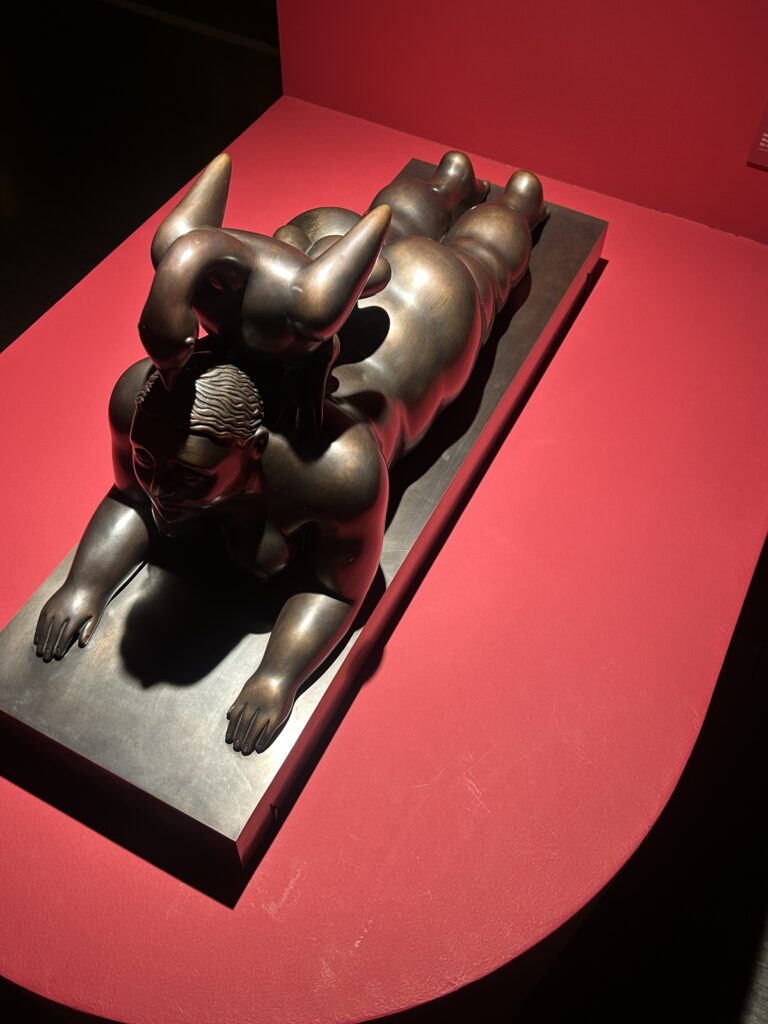
Look closely at this particular bronze masterpiece. True to Botero’s signature style, a voluptuously contoured woman lies prone, while a majestic swan arches gracefully above her, its beak gently kissing her head.
On the surface, it is a simple depiction of a reclining woman and a bird—a beautiful nod to the classical myth of Leda and the Swan. Yet, under Botero’s touch, it becomes something entirely transcendent. He masterfully infuses the cold, heavy bronze with a warmth that feels incredibly tactile, sensual, and, above all, generous. It is a flawless execution of his artistic universe, capturing the delicate line where massive weight meets soft, poetic intimacy.
The Circus: A Sanctuary for Imagination
“The circus offers a world completely separated from reality, a place where you can deploy all possible imagination,” Botero once shared. This thematic section feels like entering a beautifully melancholic twilight zone. Acrobats, tightrope walkers, and clowns are rendered with his signature majestic bulk, turning gravity-defying feats into poetic, slow-motion dreams. By stepping away from everyday logic, this theme provides a deep sense of visual liberation, turning the circus tent into a sanctuary for the creative spirit.
Within this series, one piece that commands a lingering gaze is “Clowns on Stilts.”
The Quiet Pathos Behind the Smile: “Clowns on Stilts”
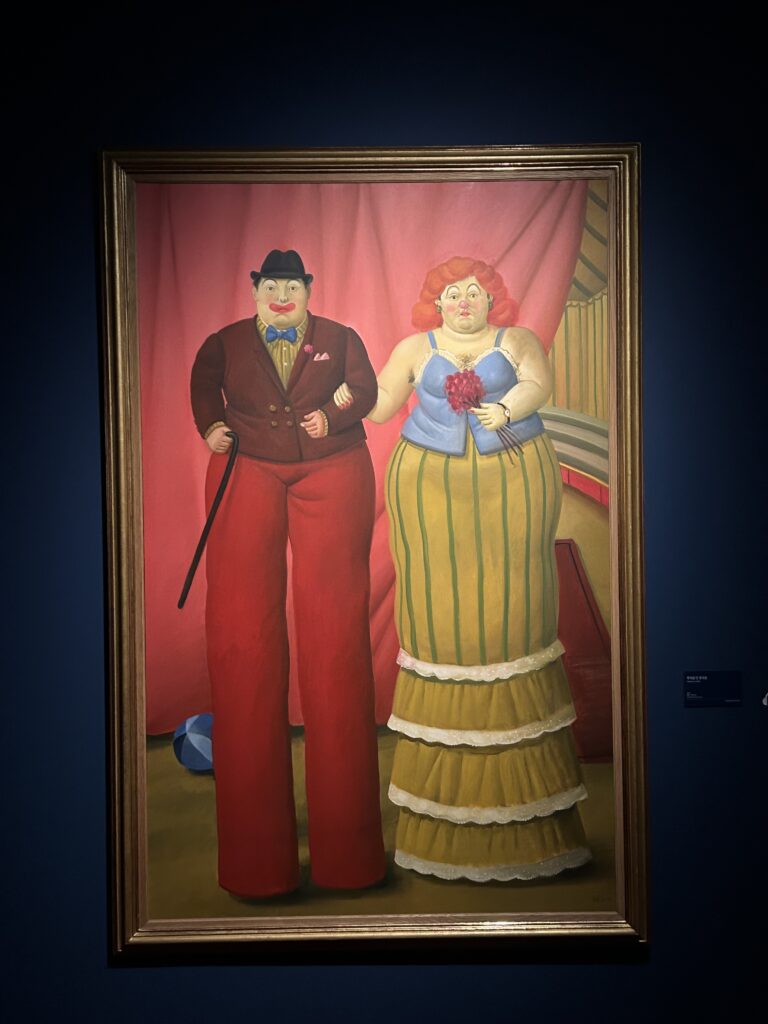
In this striking canvas, a male and a female clown stand tall on stilts—devices designed purely to elevate them for the audience’s amusement. Curiously, they are locking arms and holding what looks remarkably like a wedding bouquet, as if they are capturing a solemn matrimonial moment amidst the circus chaos. They are performers whose sole purpose in life is to bring laughter and joy to others, yet their own faces remain completely blank, wiped clean of any emotion.
This profound contrast gets to the very heart of Botero’s philosophy. He seemed to view the circus not just as entertainment, but as a poignant mirror to human existence—a beautiful blend of joy, sorrow, hardship, and resilience. Ultimately, he saw both the circus and his own art as a much-needed sanctuary for the weary soul, a sentiment he captured beautifully when he said:
“Art should provide pleasure. It should be a constant celebration of life, and an oasis from its difficulties.”
An Oasis from the Ordinary: Why Botero is the Perfect Summer Escape
Walking through “Fernando Botero: The Aesthetics of Form” at the Hangaram Art Museum is an immersive experience in radical joy. At a time when the world often feels complicated and restrictive, Botero’s world is a pure, unadulterated embrace of abundance. His deliberate, dramatic volumes don’t distort; they elevate, remind us of the dignity in being, and finding the profound humor in the mundane.
This exhibition, curated with such vibrant care, feels like a necessary indulgence for the soul. Botero’s philosophy—that art should be a sanctuary, a moment of profound pleasure—is a powerful prescription for our times. His work doesn’t demand over-analysis; it simply asks you to observe, to feel, and to perhaps leave with a slightly wider smile. If you are in Seoul this summer and need an escape that is both intellectually stimulating and beautifully liberating, this magnificent retrospective is your destination.
“Fernando Botero: The Aesthetics of Form” will be enchanting visitors at the Hangaram Art Museum through August 30, 2026. Don’t miss this chance to step into a universe where everything is fuller, softer, and filled with a rare, generous love for life.
| Key Exhibition Theme | Featured Masterpiece | What Makes It Special? |
| 1. Latin American Life | The End of the Festival | Captures the raw, unapologetic joy and realistic drama of local culture. |
| 2. Art History Reimagined | The Arnolfini Portrait, after Jan van Eyck | A playful, voluminous parody of 15th-century classical realism. |
| 3. Tactile Bronze Sculptures | The Widow (Sculpture/Painting) | Explores the profound harmony between heavy bronze and sensual volume. |
| 4. The Melancholic Circus | Clowns on Stilts | A poignant mirror to human life, serving as an oasis from reality. |
Your Inside Guide
- Exhibition Period: Now open through August 30, 2026
- Location: Hangaram Art Museum, Seoul Arts Center (240-1 Banpo-daero, Seocho-gu, Seoul)
- Getting There: A short 10-minute walk from Seocho Station (Line 2) or a quick ride on the green ‘Seocho 11’ bus.
- Edit Tip: After the exhibition, take a meditative stroll through the surrounding Seoul Arts Center garden. It’s the perfect place to sit with a coffee and reflect on Botero’s lessons of abundance.
You Might Also Like:
- If you loved Botero’s warmth, contrast it with the sharp, provocative edge of contemporary British art currently taking over the city. The National Museum of Modern and Contemporary Art (MMCA) Seoul is hosting a jaw-dropping retrospective of Damien Hirst, famous for his radical explorations of life and iconic luxury fashion collaborations. Discover the [6 absolute must-see masterpieces] at this exhibition, from his mesmerizing butterfly canvases to his infamous preserved installations.
- Dive deeper into the cultural waves driving the city’s global status in our previous feature: [A Millennial’s Guide to K-Pop History: Generations 1 to 5 Explained].
- Looking for the ultimate indoor Seoul experience? This comprehensive guide takes you inside the sprawling labyrinth of the COEX Mall, revealing the perfect itinerary for culture lovers. From hunting down the latest K-Beauty trends to getting lost in the breathtaking, floor-to-ceiling Starfield Library, these are the 7 essential spots you simply cannot miss in the heart of Samseong-dong. [7 Essential Stops in COEX: From K-Beauty to Iconic Landmarks]
- If you want to experience how locals truly unwind after a hectic week in the city, a traditional Korean bathhouse is an absolute must. This step-by-step local’s guide demystifies the entire Jjimjilbang culture, walking you through everything from the soaking pools to the relaxing clay saunas. Discover the best premium wellness spa tucked away in Gangnam, including insider favorites like Club K Spa. [6 Steps to Enjoy a Korean Jjimjilbang: A Local’s Guide to Gangnam’s Best Spa]
- Stepping into an Olive Young store for the first time can be completely overwhelming with thousands of viral skincare and makeup products filling the shelves. To save you from guessing games, I’ve curated a definitive list of the absolute holy grail items that actual Seoulites swear by. Don’t wrap up your souvenir shopping without checking off these 10+ rigorously tested, editor-approved K-Beauty must-buys. [Don’t Leave Seoul Without These: 10+ Olive Young Must-Buys]
- To truly understand the dynamic energy of Gangnam, you need to understand the subtle but fascinating invisible borders that shape its local identity. This deep-dive neighborhood guide unpacks the unique cultural, commercial, and aesthetic contrasts between the areas north and south of Teheran-ro (Taebuk and Taenam). Discover how the vibe shifts from sleek, corporate luxury to trendy, avant-garde youth hubs in a matter of blocks. [Gangnam Neighborhood Guide: 3 Key Differences Between Taebuk and Taenam]
- South Korea’s legendary ‘Pali-Pali’ (hurry-hurry) culture is more than just a mindset—it is a hyper-efficient digital infrastructure that powers daily life. This post explores 3 mind-blowing ways Korea’s high-speed lifestyle and seamless digital public services will completely reshape your expectations of urban living. From hyper-fast public Wi-Fi to futuristic delivery networks, see how Seoul operates a step ahead of the rest of the world. [3 Ways Korea’s High-Speed Lifestyle Will Amaze You]
- Ready to explore the majestic, historical heart of Seoul where ancient heritage meets hyper-modern luxury? This curated itinerary highlights the iconic Gwanghwamun square—including the exact historic spot where BTS performed for a global audience. Complete your cultural day out with a journey through contemporary masterpieces at the MMCA and a peak into the luxurious, insider experiences waiting for you at the Four Seasons Seoul. [The Ultimate Gwanghwamun Guide: BTS Performance Spot, 4 Must-Try Experiences at Four Seasons Seoul, and MMCA Art]
